Is a Mechatronics Retrofit Cheaper Than Replacing a Welding Cell?
When an aging welding cell starts losing availability, the replacement-versus-retrofit question usually appears after a costly interruption: a robot controller fault that cannot be repaired quickly, unstable arc starts, obsolete servo drives, unreliable safety circuits, or fixtures that no longer match the parts coming through the line. Production teams may see inconsistent welds and maintenance teams may be spending more time sourcing discontinued components than improving the process.
Is a mechatronics retrofit cheaper than replacing a welding cell? Often, yes—when the robot arm, base structure, guarding, positioners, and core process equipment remain mechanically sound and still fit the required production work. A retrofit can cost less because it reuses valuable physical assets while replacing the components that most affect reliability, control, safety, and weld consistency. It is not automatically the lower-cost option, however. Replacement can be financially stronger when the existing cell has structural wear, unsuitable capacity, unsupported mechanics, inadequate guarding, or limitations that make future product changes difficult.
Start with the cost of the production problem, not the equipment quote
A new welding cell has a visible purchase price. The real cost comparison is broader. The same is true for a retrofit: a lower initial proposal can become expensive if it requires major hidden work, extended debugging, or repeated compromises around old machinery.
Before comparing supplier proposals, define what the current cell is costing the operation. Look beyond maintenance invoices and include lost production time, rework, scrap, manual touch-up, unplanned overtime, spare-part lead times, and the time required to recover after a fault. A cell that runs only after frequent intervention may be cheaper to keep than to replace in the short term, but it can be a poor foundation for a modernization project.
The central question is not whether the existing robot is old. It is whether the cell has a sound mechanical platform that can support modern controls and the expected production demand for the remaining useful life of the asset.
Where retrofit savings usually come from
A mechatronics retrofit typically retains the parts that are expensive to remove, relocate, and rebuild: foundations, guarding footprint, utility connections, robot mounting, positioner structures, fume extraction interfaces, conveyors, and in some cases the robot mechanical arm. The scope then concentrates on electronics, motion control, safety, sensing, welding interfaces, and software.
Depending on the cell condition, a retrofit may include a modern robot controller, replacement servo motors or drives, cable dress packages, encoders, safety PLC hardware, interlocked doors, safety scanners, updated operator controls, welding power-source communication, arc monitoring, seam-tracking capability, and revised programming. Fixturing may also be modified to improve repeatability or accommodate a changed part family.
These upgrades can remove several causes of poor performance at once. Older controllers may have limited diagnostics; obsolete drives can create long repair delays; aging cables may produce intermittent faults; and legacy safety architectures may be difficult to validate after a modification. Replacing these elements can improve maintainability without discarding equipment that still has useful mechanical life.
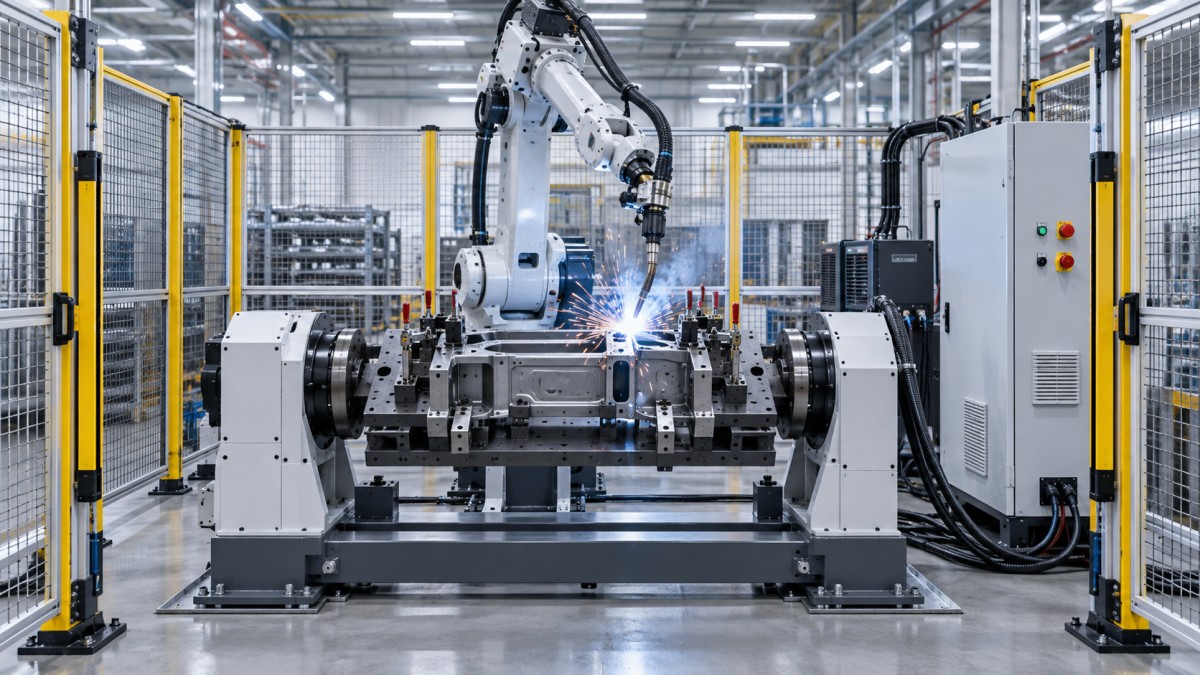
The strongest retrofit case is usually a cell with a robust physical layout but aging electrical and control components. For example, a welding positioner may remain accurate and structurally sound, yet its drive package, feedback system, and safety integration may no longer be supportable. Rebuilding those systems can be less disruptive than removing the entire station and reconstructing the work area.
When a new welding cell is likely to be the better investment
Replacement becomes more attractive when the issue is not limited to controls. A new controller cannot correct excessive backlash in a robot gearbox, worn positioner bearings, frame distortion, weak floor anchoring, poor part location, insufficient reach, or an unsafe cell layout. It also cannot create throughput that the station was never designed to achieve.
A replacement project deserves serious consideration when one or more of these conditions apply:
- The robot arm has significant mechanical wear, repeatability concerns, collision history, or an uncertain spare-parts future.
- The cell cannot achieve the required reach, payload, torch angle, axis access, or welding position for current parts.
- Cycle time is constrained by a basic layout limitation rather than controller performance.
- Fixtures require extensive rebuilding because parts have changed substantially.
- Guarding, access points, loading arrangements, and safety functions would need a near-complete redesign.
- The process needs new functions such as additional robots, coordinated external axes, automated material handling, or significantly different welding methods.
- Downtime during phased modernization would be more damaging than commissioning a prepared replacement cell.
New equipment may also provide a cleaner path for expansion. A replacement cell can be designed around future part variants, updated access requirements, improved torch serviceability, better cable routing, and more practical loading ergonomics. These benefits should be assessed carefully rather than assumed. A larger or more feature-rich cell is not necessarily better if the production mix is stable and the existing footprint already works well.
Separate mechanical condition from electrical obsolescence
One common mistake is treating a controller that has reached end of support as proof that the whole cell is obsolete. Another is assuming that a robot arm still moves smoothly, so all retained equipment is safe to keep. These are different assessments.
The mechanical review should examine robot axis behavior, brake condition, gear wear indicators, backlash, repeatability, positioner runout, fixture location accuracy, structural corrosion, weld spatter damage, cable wear, and the condition of tool center point hardware. Review the collision record if one exists. A robot that has experienced repeated crashes may require a deeper inspection even when it appears operational.
The electrical and automation review should identify unsupported controllers, drives, fieldbus networks, HMI hardware, safety relays, electrical drawings, software backups, network security exposure, and availability of qualified support. The absence of current drawings and recoverable programs is itself a project risk. A retrofit may still be viable, but the scope should include reverse engineering, documentation, and functional testing rather than assuming a simple component swap.
Do not overlook the weld process itself
Weld quality complaints are often blamed on robot age, but the root cause may sit elsewhere. Torch consumables, wire feeding, grounding, shielding gas delivery, wire alignment, fixture movement, joint fit-up, or part variation can cause defects that a new robot will not solve. A replacement decision based only on visible weld symptoms can lead to an expensive cell with the same process instability.
Review the process in production conditions. Determine whether defects occur at the same feature, after particular shifts, during long runs, or following fixture changes. Check whether the robot path is inaccurate, the part is not located consistently, or the arc process is varying. This distinction affects both project scope and expected return.
A practical comparison of the two paths
Build the retrofit scope before requesting a price
“Retrofit the welding cell” is too broad to compare accurately. Two proposals can differ widely because one includes only a controller replacement while another includes safety modernization, mechanical service, fixture correction, rewiring, documentation, and recommissioning. A low quote may exclude the items that make the cell dependable after startup.
Prepare a scope around the production objective. State the required parts, cycle time, weld quality expectations, shift pattern, planned life of the cell, available shutdown window, and any upcoming part changes. Then identify what must be retained, what must be replaced, and what needs inspection before a final decision.
- Capture baseline performance. Record planned versus actual availability, repeated fault types, cycle-time losses, repair delays, rework causes, and manual interventions. Do not rely only on anecdotal reports from individual shifts.
- Audit the retained assets. Inspect the robot, positioners, fixtures, guarding, cable routes, power distribution, pneumatic circuits, and fume extraction connections. Mark components that have uncertain condition or no practical support path.
- Define the safety modification boundary. Any significant change to controls, access, tooling, or operating modes may require a renewed risk assessment and validation of safety functions. Include this work early, not after equipment has been selected.
- Identify integration dependencies. Map interfaces to PLCs, material handling, welding power sources, plant networks, quality systems, and upstream/downstream stations. Older communication protocols and undocumented interlocks often determine the real schedule.
- Plan acceptance criteria. Specify which parts will be tested, how weld quality and cycle time will be evaluated, what fault recovery must demonstrate, and what documentation must be delivered at handover.
This preparation also reveals whether a phased retrofit is feasible. Some cells can remain productive while a new control cabinet is assembled offline, software is developed from backups, and fixtures are modified separately. Others require a complete shutdown because the robot controller, safety system, and process controls are tightly coupled. A replacement cell may have a higher capital requirement but less interference with an operating line if it can be built and tested before installation.
Downtime risk can reverse the apparent saving
Retrofit projects are frequently evaluated as though the only cost is hardware and labor. In reality, the main uncertainty is often the condition of retained equipment discovered after disassembly. A damaged connector, unavailable harness, undocumented safety circuit, worn fixture locator, or incompatible power-source interface can extend the outage.
This does not make retrofitting unreliable. It means the project needs disciplined risk control. Retain critical spare components where possible, verify software backups before shutdown, test communications off-line, define escalation paths for unknown faults, and establish which production work can be diverted during commissioning. The more dependent the operation is on one cell, the more important it is to budget time and contingency around recovery, not just installation.
Replacement projects have their own downtime risks. The new cell may arrive with a different operator workflow, part presentation method, robot reach envelope, or fixture philosophy. It can meet its design specification yet still require adjustment before it matches daily production variation. Commissioning plans should allow time for process proving, operator training, maintenance handover, and controlled ramp-up.
Safety and compliance are not optional line items
Modernizing a cell can change its risk profile even when the physical fence remains in place. New robot speeds, revised manual modes, altered loading access, additional sensors, new motion axes, or software changes can affect safeguarding performance. Safety functions should be designed and validated for the actual operating modes, including setup, recovery, maintenance, and fault clearing.
Use the applicable robot and machinery safety requirements for the installation and local regulatory environment. The review should cover emergency stops, protective stops, gate interlocks, restart prevention, enabling devices, safe speed functions where relevant, electrical isolation, pneumatic energy control, and the ability to access the torch and fixtures without creating an unsafe recovery routine. Retrofitting is not simply an electrical upgrade; it is a change to an operating machine.
Choose based on the remaining life you can defend
A retrofit is usually the economical choice when it removes the primary causes of downtime while preserving a cell that is mechanically capable, appropriately sized, and safe to modernize. It is especially compelling where the existing layout, foundations, positioners, and fixtures would be expensive to duplicate, and where production requirements are stable.
Replacing the cell is usually justified when retained mechanical equipment would continue to limit quality, output, safety, or flexibility after the control upgrade. It is also the stronger path when the business needs a fundamentally different process arrangement rather than a more reliable version of the old one.
The most defensible decision comes from comparing two complete operating scenarios: a retrofit scope that includes all necessary repairs, safety work, documentation, and commissioning; and a replacement scope that includes installation, integration, process proving, and ramp-up. When both are measured against the same production requirements and outage exposure, the cheaper option becomes much easier to identify—and far less likely to be a short-term saving that returns as another welding-cell problem.
Search News
Hot Articles
- OTR Radial TiresUS Announces Overhaul of Federal Tire Safety StandardsOct 31, 2026
- API 682 & REACH ComplianceRobot Compliance Standards: Which Safety Standards Apply to Industrial Robots?Oct 31, 2026
- Sealing TCO & OTR CapitalUS Revises Section 338 Tariffs on Canada, Sets 15% Rate for Rubber and Plastic MoldsOct 30, 2026
Popular Tags
Need ExpertConsultation?
Connect with our specialized leisureengineering team for procurementstrategies.
Recommended News