Factory Robotics ROI: What Impacts Payback Time Most
Factory robotics ROI starts long before installation
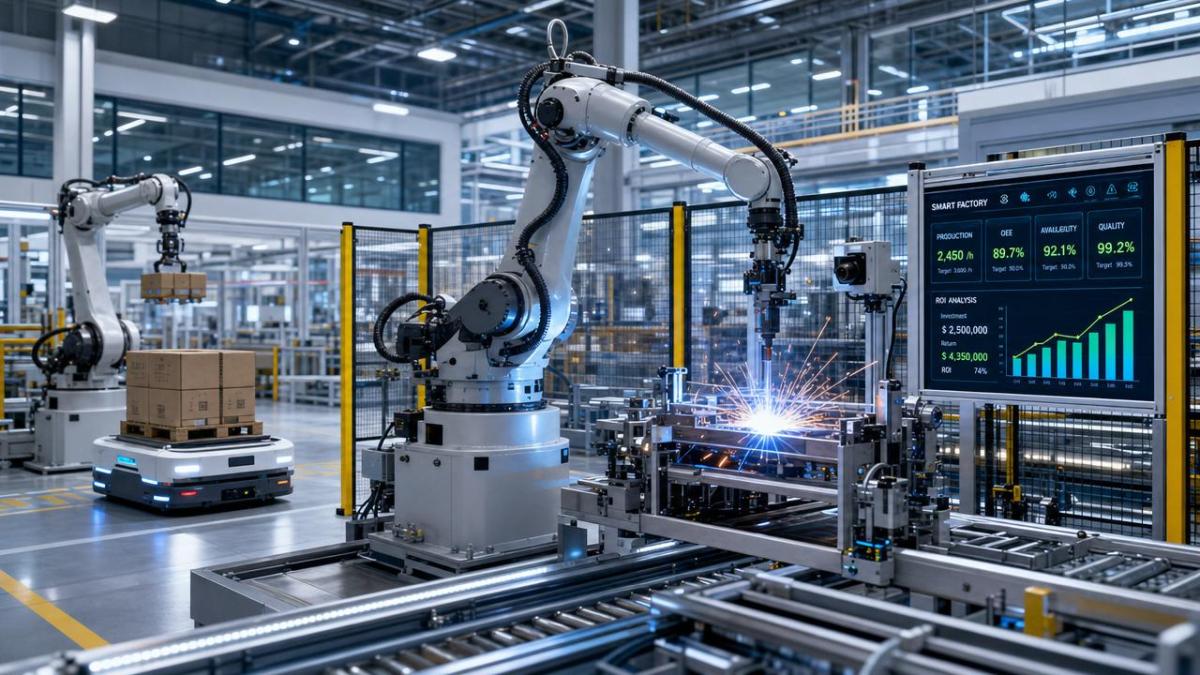
Factory robotics is often approved as equipment spending, but the real question is how fast that spending turns into measurable return.
In practice, payback time is shaped by labor economics, throughput, quality stability, integration effort, and uptime discipline.
That is why two factory robotics projects with similar hardware prices can produce very different ROI outcomes.
A welding cell, a cobot palletizing station, and an AMR fleet may all improve productivity, yet their payback logic is not identical.
More useful evaluations look at the full operating model.
This includes robot utilization, workcell balance, safety design, maintenance planning, and how well vision, EOAT, and controls fit the task.
IRSE frequently organizes these questions around smart factory payback models, compliance, and application-level performance rather than headline robot price alone.
That approach is useful when comparing industrial robots, cobots, AGV systems, AMRs, or machine vision-enabled workcells across different production environments.
What usually has the biggest impact on payback time?
The biggest factor is rarely the robot arm itself.
For most factory robotics projects, payback improves fastest when automation removes recurring cost from a bottleneck process.
That recurring cost may be direct labor, rework, scrap, overtime, line stoppages, ergonomic risk, or slow internal transport.
A six-axis robot in arc welding often pays back through repeatability and reduced defect cost.
A palletizing cobot may pay back through labor redeployment and longer operating hours.
An AMR system may justify itself through fewer forklift trips, better material flow, and lower delay between stations.
Cycle time gains matter, but only when upstream and downstream processes can absorb the extra speed.
If a robot cell runs faster than feeding, inspection, or packaging, expected ROI becomes theoretical.
The more reliable payback driver is usable output per shift, not peak speed on a specification sheet.
Another high-impact variable is schedule density.
Factory robotics usually pays back faster in multi-shift operations, high-mix lines with stable repeat tasks, and environments with persistent labor pressure.
A practical way to rank ROI drivers
Before approval, it helps to compare the main payback drivers side by side.
This kind of table prevents a common mistake.
A project that looks inexpensive at purchase can still be slow to pay back if commissioning drags on or uptime stays unstable.
Is labor saving still the main factory robotics business case?
Yes, but it is no longer the only strong case.
Factory robotics often enters approval discussions through labor reduction, especially in repetitive handling, welding, packing, and intralogistics tasks.
However, many of the fastest payback projects combine labor savings with quality and throughput improvements.
Consider robotic welding with vision and servo-controlled motion.
The value may come from fewer weld defects, less fixture variation, lower rework hours, and better shift-to-shift consistency.
That blended value is often more durable than labor savings alone.
The same pattern appears in machine vision inspection cells.
A defect detection system using industrial cameras, AI models, and edge computing may not remove many operators.
Still, it can shorten payback by reducing escapes, claims, and uncertainty in quality release.
In actual factory robotics planning, the stronger business case is often a stack of smaller gains that reinforce each other.
- Lower direct labor or overtime cost
- Higher throughput during the same shift pattern
- Reduced scrap, rework, and process variation
- Improved safety in hot, heavy, or repetitive tasks
- More stable planning for delivery and capacity
When these gains are combined, payback models become more credible and less sensitive to one assumption being wrong.
Why do some factory robotics projects miss the expected ROI?
Most disappointments start with an incomplete baseline.
If the current process is not measured accurately, the future savings estimate becomes guesswork.
This happens when labor assumptions ignore absenteeism, when defect costs exclude downstream effects, or when cycle time ignores micro-stoppages.
Another issue is underestimating integration depth.
Factory robotics rarely works as a stand-alone device.
The robot may depend on grippers, torque sensors, cameras, conveyors, safety fencing, software interfaces, or SLAM navigation in mobile deployments.
Each interface affects timeline, risk, and commissioning cost.
A third source of missed ROI is poor fit between automation and process variability.
If parts arrive with inconsistent orientation, reflectivity, dimensions, or material behavior, performance may depend heavily on machine vision and EOAT quality.
That does not make the project weak, but it changes the business case.
More engineering is needed, and payback should reflect that reality.
Compliance can also affect timing.
Safety design aligned with ISO 10218 or, for collaborative applications, ISO/TS 15066 should be treated as part of project economics, not a late addition.
Signals that an ROI model needs another review
- Savings rely on ideal cycle time, not observed output
- Changeover effort is described loosely
- No clear assumption for spare parts and service
- The vision system or gripper is still undefined
- Layout changes and safety validation are excluded
How should factory robotics options be compared across different applications?
The useful comparison is not robot versus robot.
It is operating model versus operating model.
A low-cost cobot may look attractive, but if payload, reach, or takt time are marginal, the project may cap future output.
A larger industrial robot may cost more initially, yet support better uptime and lower unit cost over time.
The same logic applies to AGV and AMR decisions.
AGV systems may suit structured, repeat routes.
AMRs may deliver more flexibility where layouts, priorities, and traffic conditions change frequently.
Payback depends on route stability, fleet software, docking logic, and material handling discipline.
A grounded comparison usually includes these checks.
- Required throughput at normal, not peak, operating conditions
- Part variation and how vision or sensing handles it
- Tooling life, consumables, and maintenance intervals
- Programming effort for new SKUs or route changes
- Expansion path for future lines or additional cells
IRSE often frames these comparisons through application cases because component choices only make sense in context.
A vision-guided pick cell, a robotic welding station, and a mobile robot fleet should not share the same payback assumptions.
What is the smartest next step before approving a factory robotics project?
The smartest next step is to test the business case against actual process data, not vendor optimism.
That means documenting current labor use, downtime, defect rates, shift pattern, changeover loss, and material flow delays.
Then compare that baseline with a realistic factory robotics model that includes integration, safety, training, and maintenance.
A strong review usually asks a short set of practical questions.
- Which process constraint is this project actually removing?
- Which savings are immediate, and which are conditional?
- What assumptions depend on vision, EOAT, or software maturity?
- How long until stable production, not just mechanical installation?
- Does the cell stay valuable if product mix changes next year?
Factory robotics delivers the best ROI when the investment is linked to a measurable production constraint and engineered for stable use.
The most reliable approvals are usually based on whole-system economics, not isolated equipment quotes.
If the next evaluation step is still open, start by ranking payback drivers, validating baseline data, and comparing solutions by application fit.
That makes factory robotics decisions clearer, more defensible, and far more likely to deliver the return originally promised.
Search News
Hot Articles
- API 682 & REACH ComplianceWhere Edge Computing Delivers the Most Value in Industrial Robotics CellsSep 15, 2026
- API 682 & REACH ComplianceHow to Evaluate Robot Torque Sensor Manufacturers for Precision Assembly LinesSep 14, 2026
- API 682 & REACH ComplianceSelecting an Industrial Sensing Manufacturer: Calibration, Traceability, and DeliverySep 13, 2026
Popular Tags
Need ExpertConsultation?
Connect with our specialized leisureengineering team for procurementstrategies.
Recommended News